
by Ranger Jennifer Cox
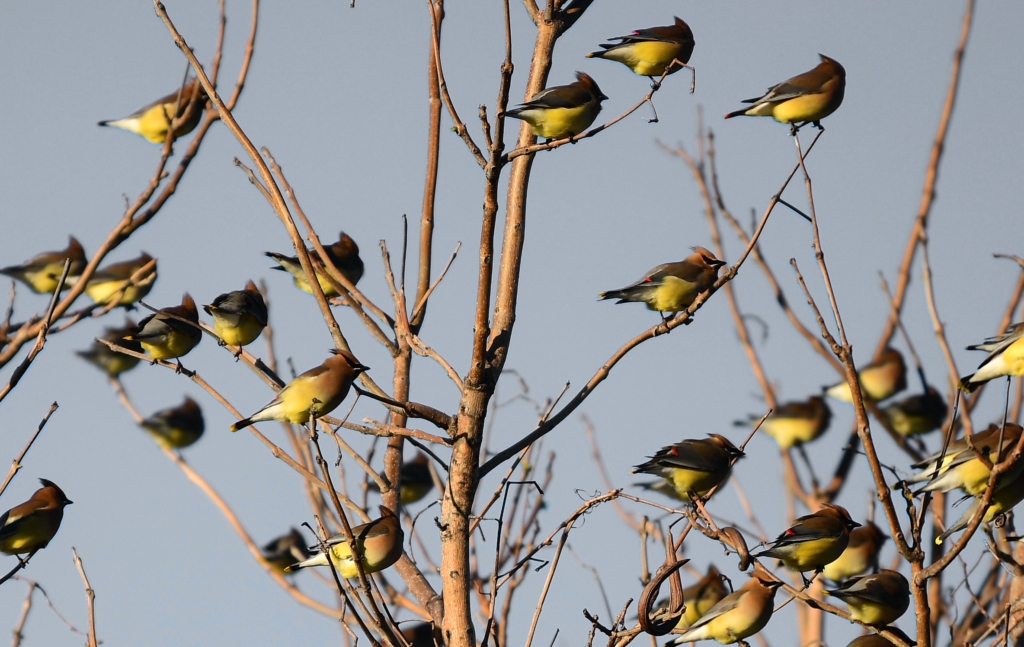
Birds come in so many beautiful variations that it is hard for me to pinpoint one particular species that is my favorite. I love the intelligence and shenanigans of the crows, the stateliness of the Great Blue Heron, the silent precision of owls, and the oversized confidence of petite chickadees. But there is one bird I see during spring and fall that always takes my breath away with its beauty: the Cedar Waxwing. Their high-pitched calls give them away first. Once I hear them it does not take long to find a group, called a museum or earful, high up in a tree nearby. The area that I see the waxwings in the park is full of cedar trees and yaupon holly bushes that provide berries for them to feast on.
There are two species of waxwings in North America. The Bohemian waxwing is a more northern species. It summers in Canada and the more western states of the United States. It is extremely rare to see them in North Carolina and most sightings are attributed to a misidentification. Cedar Waxwings (Bombycilla cedrorum) can be found year-round in the mountains of North Carolina and during the cooler months in the Piedmont and Coastal Plain. During the summer breeding months, they are found further north from Virginia into Canada and in higher elevations.
The Cedar Waxwing is a beautiful bird that is easily identified by its brightly colored features. A black mask across their eyes leads to a sharp crest on the top of its head. The rest of its head is a muted red-brown that fades into a pleasant grey on its back leading to a darker tail and finishes with a bright lemon yellow (or orange depending on diet) band at the end of its tail. A striking buttery yellow is easily spotted on the belly. The secondary feathers of its wings have a bright flash of red on their tips from a waxy secretion, hence the name. The red tip indicates the bird is of a mature age and helps them attract a mate. The male and female are very similar except for a darker chin on the males.
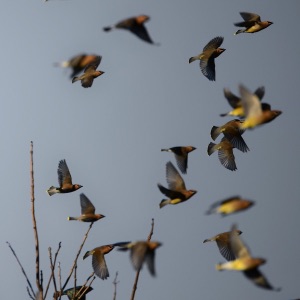
These birds are frugivores, feasting on small fruits and berries but will also eat some bugs for protein intake. I mentioned their tail tips being orange on some birds. This is due to those individuals eating an introduced honeysuckle. Birders did not observe this tail color difference until the 1960’s after the introduction of a non-native honeysuckle in North America. They will eat their weight in fruit and berries sometimes finding themselves intoxicated after a meal of over-ripened fermented berries. To attract waxwings to your yard plant a variety of native shrubs and trees that produce berries.
I am sharing two photographs of a museum of Cedar Waxwings in the park on the chilly morning of March 17, 2026. I hope you enjoy them.