
by Ranger Austin Paul
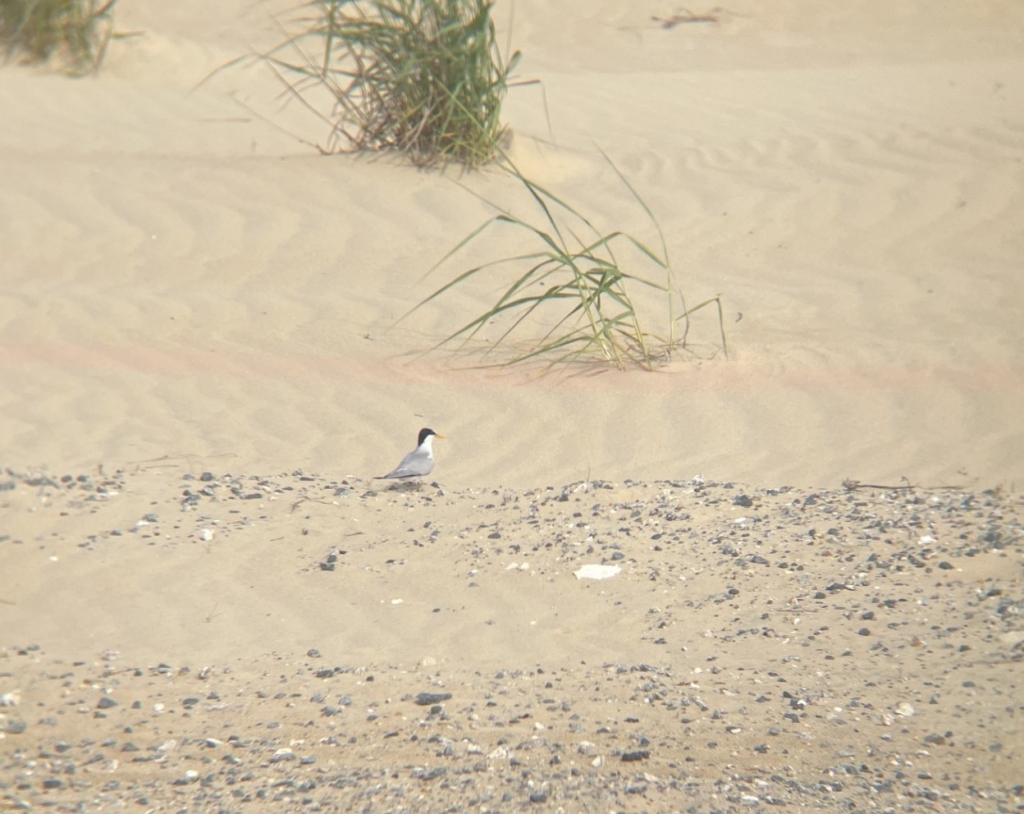
In late May, while out hiking with her pup, Friends board member Holly Nettles discovered an excitement occurrence. Nettles observed what appeared to be a bird’s egg resting directly on the surface of sand along the southeastern area of the big dunes. After reporting the sighting to park officials, it was determined to be a Least Tern egg.
Park staff wasted no time leaping into action. Patrol of all open dune areas was conducted for signs of nesting. Four active sites were located. This was truly a “all hands-on deck” mission. By that afternoon these sensitive areas were established as public use closures. Signage was posted around the parameter of each site informing visitors of nesting activity. From what ranger staff recall, this is the first closure of its kind to occur within the park.
A little background and what to expect throughout the summer season.
This migratory bird arrives mid-April through mid-September to set up its summertime home. They are part of the Laridae family, which includes terns, gulls, and skimmers. Terns are extremely social within its own species. Open sandy environments found along barrier islands provide preferred nesting areas, where seasonal colonies are established. Courtship behavior includes males strutting around with a small fish to attract a mate. They also perform aerial acrobatics in hopes of winning over a bride.
While hiking, keep an eye out for shallow depressions. These are potential nests the birds scrape out to cradle their eggs. Chicks are introduced to the world after a hatching period of 21 days and will pursue nearby shelter to escape predators. Chicks will advance to flight status (fledgling) by August but remain with adults for one to two more months. We expect by late August/early September for our new feathered friends to fly as far south as the Caribbean to overwinter.
Will they join us in 2027?
It is possible, but they are not bound to one specific site each year. Relocation of nesting areas are dictated by various factors including wildlife predation, human disturbance (high foot traffic and other recreational activities), and of course loss of habitat seen through development and shoreline erosion.
So, what can we do to help them?
Least Terns are listed as a Species of Special Concern.
- Stay out of posted nesting closures.
- Because they are ground-nesters, keep a close eye for scraped depressions and eggs.
- Terns may be very vocal if you approach. Identify them by their high-pitched squeaky call.
- Maintain a safe distance to avoid any disturbance. Minimum of 300’.
- Always keep dogs on a leash.
- Report violations to park staff.